

OMADA HEALTH — INTERNSHIP 2025
Removing Friction, Driving Enrollment
During the summer of 2025, I joined Omada Health's Enrollment & Growth team as a Product Grad Intern, working alongside a Senior PM to tackle a deceptively simple question: what friction stands between an eligible user and their first step in the program? Over 3 months, I led two interconnected workstreams — a competitive analysis of onboarding flows across the digital health landscape and a live A/B test reaching 12,000+ users — that together shaped roadmap priorities and produced measurable gains in enrollment conversion.
⚠️ To comply with confidentiality agreements, specific metrics, flows, and internal details have been modified or removed. I welcome the opportunity to discuss my contributions further.
Proving One Field Really Matters
My Role
Product Grad Intern
Stakeholders
PMs / Engineering / Marketing / Sales
Timeline
3 months
Tools
Figma / Miro / Amplitude / Tableau
The Problem
Eligible users were dropping off during onboarding at the access code field — an 8-digit code sent via email that required leaving the application page. This created roughly a 7% drop-off rate. With client demand shifting and competitors removing access codes, the question became: Does this field actually impact conversion?
The Test
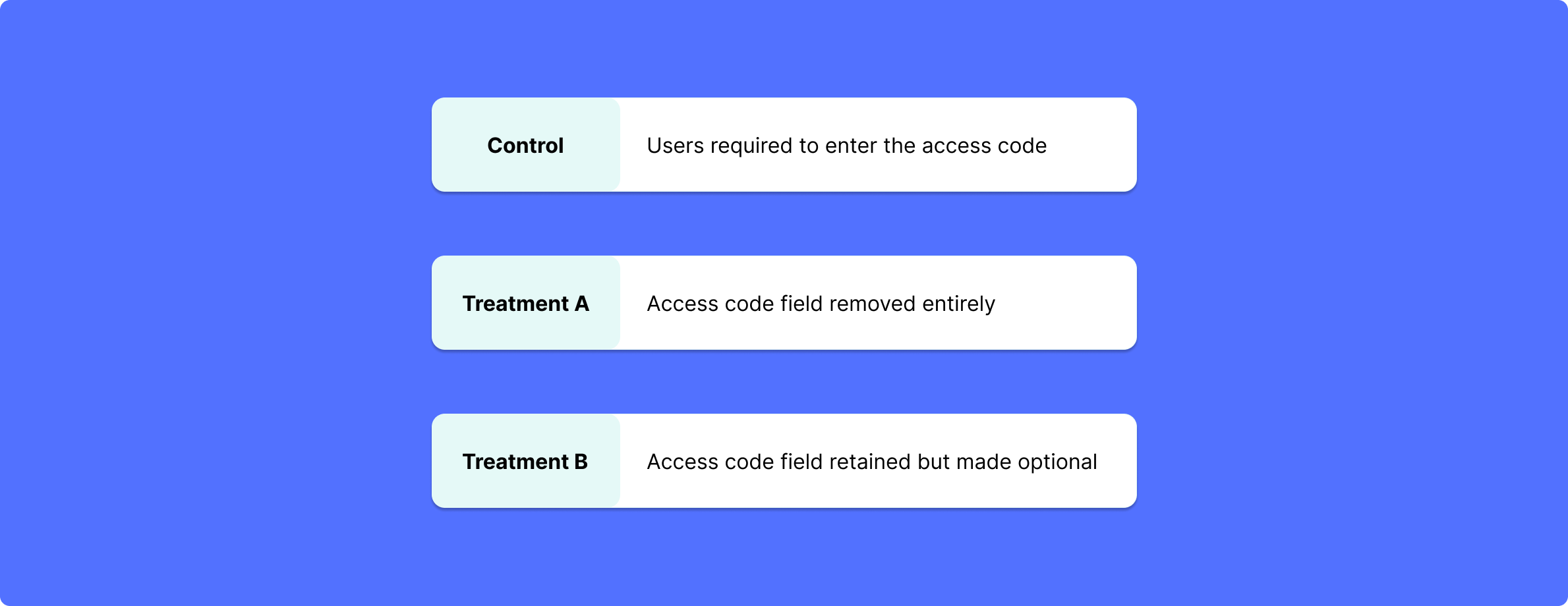
Designed and executed an A/B test across 12,000+ users with two treatment arms and one control group.
The Result
Removing the access code field drove a 6.24% lift in application-to-enrollment submissions. The change was shipped in October 2025.
What Competitors Revealed About Application Friction
My Role
Product Grad Intern
Stakeholders
PMs / Engineering / Marketing / UXD/UXR / Sales
Timeline
3 months
Tools
Figma / Miro / LLMs
The Problem
Omada hadn't benchmarked its onboarding against competitors in three years. Users arrived motivated but dropped off due to confusion around the program's scope.
The Process
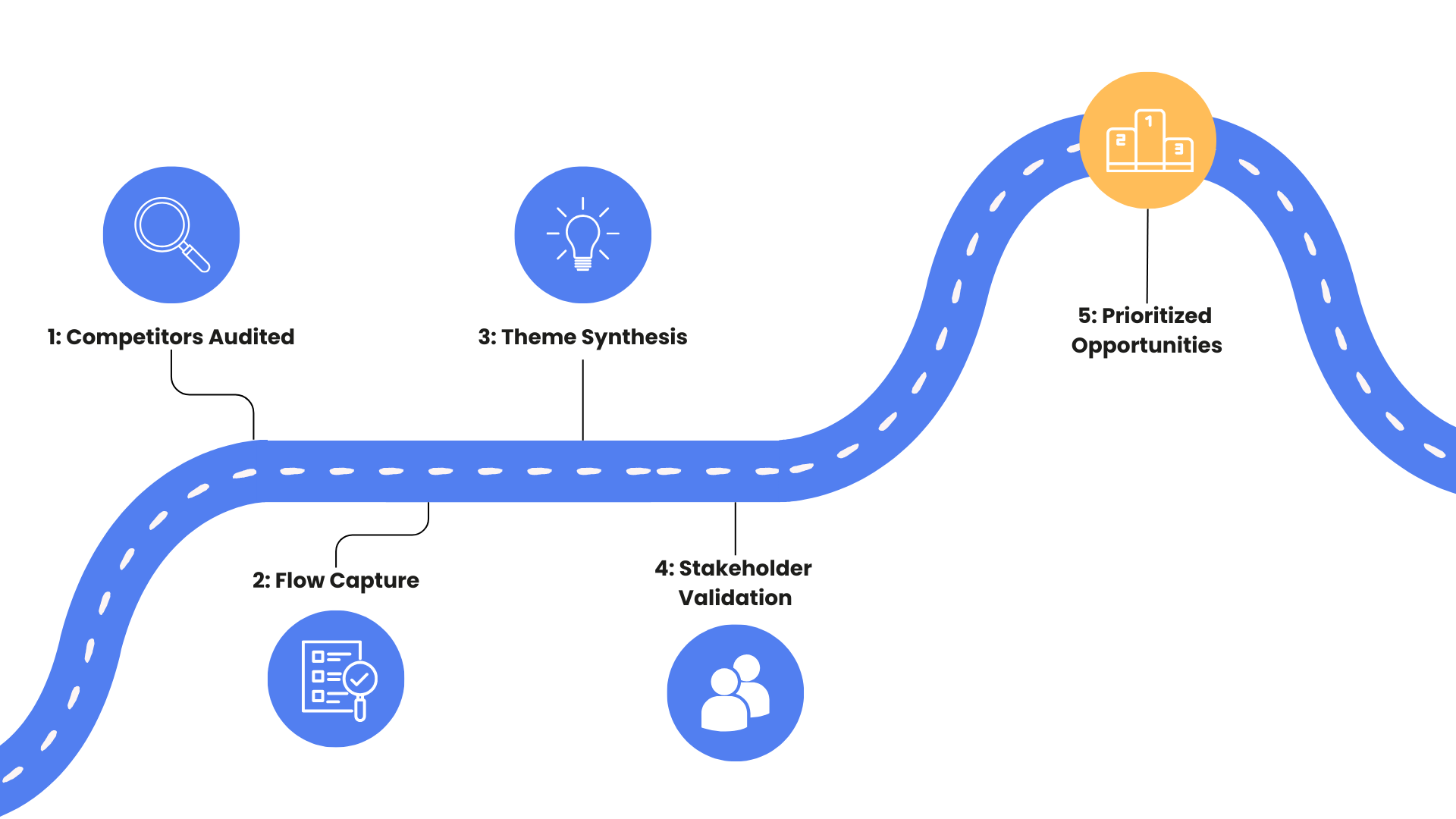
First-hand competitive audit across 12 platforms (direct, adjacent, and out-of-category competitors) — documented every experience screen by screen.

The Recommendations
Simplify the journey: Reorder Omada's application flow to front-load eligibility criteria before behavioral questions, and consolidate fields split across panels into a single welcome screen.
Personalize to build confidence: Dynamically surface relevant outcomes, peer stats, and condition-specific messaging using inputs users had already provided — modeled after Noom Med and WW.
Use branding to drive excitement: Add a lightweight product preview moment post-account creation to close the gap with WW, Noom, and MasterClass.
The Result
Analysis was presented at internship close, delivering a prioritized framework for onboarding improvements organized by level of effort and potential impact.
From Insight to Roadmap, and Where I'd Take It Next
This internship reinforced that the most impactful product decisions aren't always the most complex ones. A single form field was quietly eroding conversion at scale, and a competitive landscape untouched for three years was leaving clear opportunities on the table. What unlocked both was pairing strong product instincts with rigorous process — controlled experimentation on one side, firsthand research on the other. Equally important was learning how to make findings land. Building credibility with cross-functional stakeholders required grounding every insight in evidence and connecting it clearly to business outcomes. Good analysis doesn't speak for itself — it needs to be shaped for the audience it's meant to move.
Next Project
